In physics and thermodynamics, an equation of state is a thermodynamic equation relating state variables which describe the state of matter under a given set of physical conditions, such as pressure, volume, temperature (PVT), or internal energy.[1] Equations of state are useful in describing the properties of fluids, mixtures of fluids, solids, and the interior of stars.
Overview
At present, there is no single equation of state that accurately predicts the properties of all substances under all conditions. An example of an equation of state correlates densities of gases and liquids to temperatures and pressures, known as the ideal gas law, which is roughly accurate for weakly polar gases at low pressures and moderate temperatures. This equation becomes increasingly inaccurate at higher pressures and lower temperatures, and fails to predict condensation from a gas to a liquid.
Another common use is in modeling the interior of stars, including neutron stars, dense matter (quark–gluon plasmas) and radiation fields. A related concept is the perfect fluid equation of state used in cosmology.
Equations of state can also describe solids, including the transition of solids from one crystalline state to another.
In a practical context, equations of state are instrumental for PVT calculations in process engineering problems, such as petroleum gas/liquid equilibrium calculations. A successful PVT model based on a fitted equation of state can be helpful to determine the state of the flow regime, the parameters for handling the reservoir fluids, and pipe sizing.
Measurements of equation-of-state parameters, especially at high pressures, can be made using lasers.[2][3][4]
Historical
Boyle's law (1662)
Boyle's Law was perhaps the first expression of an equation of state.[citation needed] In 1662, the Irish physicist and chemist Robert Boyle performed a series of experiments employing a J-shaped glass tube, which was sealed on one end. Mercury was added to the tube, trapping a fixed quantity of air in the short, sealed end of the tube. Then the volume of gas was measured as additional mercury was added to the tube. The pressure of the gas could be determined by the difference between the mercury level in the short end of the tube and that in the long, open end. Through these experiments, Boyle noted that the gas volume varied inversely with the pressure. In mathematical form, this can be stated as:

The above relationship has also been attributed to Edme Mariotte and is sometimes referred to as Mariotte's law. However, Mariotte's work was not published until 1676.
Charles's law or Law of Charles and Gay-Lussac (1787)
In 1787 the French physicist Jacques Charles found that oxygen, nitrogen, hydrogen, carbon dioxide, and air expand to roughly the same extent over the same 80-kelvin interval. Later, in 1802, Joseph Louis Gay-Lussac published results of similar experiments, indicating a linear relationship between volume and temperature (Charles's Law):

Dalton's law of partial pressures (1801)
Dalton's Law of partial pressure states that the pressure of a mixture of gases is equal to the sum of the pressures of all of the constituent gases alone.
Mathematically, this can be represented for n species as:

The ideal gas law (1834)
In 1834, Émile Clapeyron combined Boyle's Law and Charles' law into the first statement of the ideal gas law. Initially, the law was formulated as pVm = R(TC + 267) (with temperature expressed in degrees Celsius), where R is the gas constant. However, later work revealed that the number should actually be closer to 273.2, and then the Celsius scale was defined with 0 °C = 273.15 K, giving:

Van der Waals equation of state (1873)
In 1873, J. D. van der Waals introduced the first equation of state derived by the assumption of a finite volume occupied by the constituent molecules.[5] His new formula revolutionized the study of equations of state, and was most famously continued via the Redlich–Kwong equation of state[6] and the Soave modification of Redlich-Kwong.[7]
General form of an equation of state
For a given amount of substance contained in a system, the temperature, volume, and pressure are not independent quantities; they are connected by a relationship of the general form
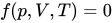
An equation used to model this relationship is called an equation of state. In the following sections major equations of state are described, and the variables used here are defined as follows. Any consistent set of units may be used, although SI units are preferred. Absolute temperature refers to use of the Kelvin (K) or Rankine (°R) temperature scales, with zero being absolute zero.
, pressure (absolute)
, volume
, number of moles of a substance
,
, molar volume, the volume of 1 mole of gas or liquid
, absolute temperature
, ideal gas constant ≈ 8.3144621 J/mol·K
, pressure at the critical point
, molar volume at the critical point
, absolute temperature at the critical point
Classical ideal gas law
The classical ideal gas law may be written

In the form shown above, the equation of state is thus
.
If the calorically perfect gas approximation is used, then the ideal gas law may also be expressed as follows
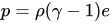
where 


Quantum ideal gas law
Since for atomic and molecular gases, the classical ideal gas law is well suited in most cases, let us describe the equation of state for elementary particles with mass 



where 


In the limiting case where 
![{\displaystyle pV=Nk_{B}T\left[1\pm {\frac {\pi ^{3/2}}{2(2s+1)}}{\frac {N\hbar ^{3}}{V(mk_{B}T)^{3/2}}}+\cdots \right]}](https://wikimedia.org/api/rest_v1/media/math/render/svg/ef692eee683dd0f2db91919df6547fdc4e25b180)
With a fixed number density 
Cubic equations of state
Cubic equations of state are called such because they can be rewritten as a cubic function of 
Van der Waals equation of state
The Van der Waals equation of state may be written:
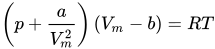
where 


Also written as
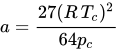

Proposed in 1873, the van der Waals equation of state was one of the first to perform markedly better than the ideal gas law. In this landmark equation
The van der Waals equation may be considered as the ideal gas law, "improved" due to two independent reasons:
- Molecules are thought as particles with volume, not material points. Thus
) instead of
- While ideal gas molecules do not interact, we consider molecules attracting others within a distance of several molecules' radii. It makes no effect inside the material, but surface molecules are attracted into the material from the surface. We see this as diminishing of pressure on the outer shell (which is used in the ideal gas law), so we write (
something) instead of
~
.
With the reduced state variables, i.e. 


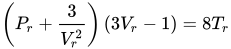
The benefit of this form is that for given 


For 

Redlich-Kwong equation of state[6]
![{\displaystyle {\begin{aligned}p&={\frac {R\,T}{V_{m}-b}}-{\frac {a}{{\sqrt {T}}\,V_{m}\left(V_{m}+b\right)}}\\[3pt]a&\approx 0.42748{\frac {R^{2}\,T_{c}^{\frac {5}{2}}}{p_{c}}}\\[3pt]b&\approx 0.08664{\frac {R\,T_{c}}{p_{c}}}\end{aligned}}}](https://wikimedia.org/api/rest_v1/media/math/render/svg/76af7621de77a84d9aa661afc810edddcc65fdf4)
Introduced in 1949, the Redlich-Kwong equation of state was a considerable improvement over other equations of the time. It is still of interest primarily due to its relatively simple form. While superior to the van der Waals equation of state, it performs poorly with respect to the liquid phase and thus cannot be used for accurately calculating vapor–liquid equilibria. However, it can be used in conjunction with separate liquid-phase correlations for this purpose.
The Redlich-Kwong equation is adequate for calculation of gas phase properties when the ratio of the pressure to the critical pressure (reduced pressure) is less than about one-half of the ratio of the temperature to the critical temperature (reduced temperature):

Soave modification of Redlich-Kwong[7]
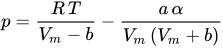
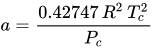
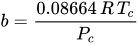


Where ω is the acentric factor for the species.
This formulation for 

for hydrogen:

We can also write it in the polynomial form, with:


then we have:

where 
In 1972 G. Soave[9] replaced the 1/√T term of the Redlich-Kwong equation with a function α(T,ω) involving the temperature and the acentric factor (the resulting equation is also known as the Soave-Redlich-Kwong equation of state; SRK EOS). The α function was devised to fit the vapor pressure data of hydrocarbons and the equation does fairly well for these materials.
Note especially that this replacement changes the definition of a slightly, as the
Volume translation of Peneloux et al. (1982)
The SRK EOS may be written as

where
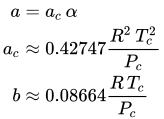
where
A downside of the SRK EOS, and other cubic EOS, is that the liquid molar volume is significantly less accurate than the gas molar volume. Peneloux et alios (1982)[10] proposed a simple correction for this by introducing a volume translation

where 
In the first version only 

In the second version both 
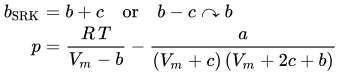
The c-parameter of a fluid mixture is calculated by

The c-parameter of the individual fluid components in a petroleum gas and oil can be estimated by the correlation

where the Rackett compressibility factor 

A nice feature with the volume translation method of Peneloux et al. (1982) is that it does not affect the vapor-liquid equilibrium calculations.[14] This method of volume translation can also be applied to other cubic EOSs if the c-parameter correlation is adjusted to match the selected EOS.
Peng–Robinson equation of state
![{\displaystyle {\begin{aligned}p&={\frac {R\,T}{V_{m}-b}}-{\frac {a\,\alpha }{V_{m}^{2}+2bV_{m}-b^{2}}}\\[3pt]a&\approx 0.45724{\frac {R^{2}\,T_{c}^{2}}{p_{c}}}\\[3pt]b&\approx 0.07780{\frac {R\,T_{c}}{p_{c}}}\\[3pt]\alpha &=\left(1+\kappa \left(1-T_{r}^{\frac {1}{2}}\right)\right)^{2}\\[3pt]\kappa &\approx 0.37464+1.54226\,\omega -0.26992\,\omega ^{2}\\[3pt]T_{r}&={\frac {T}{T_{c}}}\end{aligned}}}](https://wikimedia.org/api/rest_v1/media/math/render/svg/76b0fb3bcb60fc74628c1460f5ef109cdad6a7b7)
In polynomial form:



where 
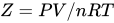
The Peng–Robinson equation of state (PR EOS) was developed in 1976 at The University of Alberta by Ding-Yu Peng and Donald Robinson in order to satisfy the following goals:[15]
- The parameters should be expressible in terms of the critical properties and the acentric factor.
- The model should provide reasonable accuracy near the critical point, particularly for calculations of the compressibility factor and liquid density.
- The mixing rules should not employ more than a single binary interaction parameter, which should be independent of temperature, pressure, and composition.
- The equation should be applicable to all calculations of all fluid properties in natural gas processes.
For the most part the Peng–Robinson equation exhibits performance similar to the Soave equation, although it is generally superior in predicting the liquid densities of many materials, especially nonpolar ones.[16] The departure functions of the Peng–Robinson equation are given on a separate article.
The analytic values of its characteristic constants are:



Peng–Robinson-Stryjek-Vera equations of state
PRSV1
A modification to the attraction term in the Peng–Robinson equation of state published by Stryjek and Vera in 1986 (PRSV) significantly improved the model's accuracy by introducing an adjustable pure component parameter and by modifying the polynomial fit of the acentric factor.[17]
The modification is:

where 


PRSV2
A subsequent modification published in 1986 (PRSV2) further improved the model's accuracy by introducing two additional pure component parameters to the previous attraction term modification.[18]
The modification is:
![{\displaystyle {\begin{aligned}\kappa &=\kappa _{0}+\left[\kappa _{1}+\kappa _{2}\left(\kappa _{3}-T_{r}\right)\left(1-T_{r}^{\frac {1}{2}}\right)\right]\left(1+T_{r}^{\frac {1}{2}}\right)\left(0.7-T_{r}\right)\\\kappa _{0}&=0.378893+1.4897153\,\omega -0.17131848\,\omega ^{2}+0.0196554\,\omega ^{3}\end{aligned}}}](https://wikimedia.org/api/rest_v1/media/math/render/svg/839e586ab76a17eede9adbc715084a6b0f0b4ab9)
where 

PRSV2 is particularly advantageous for VLE calculations. While PRSV1 does offer an advantage over the Peng–Robinson model for describing thermodynamic behavior, it is still not accurate enough, in general, for phase equilibrium calculations.[17] The highly non-linear behavior of phase-equilibrium calculation methods tends to amplify what would otherwise be acceptably small errors. It is therefore recommended that PRSV2 be used for equilibrium calculations when applying these models to a design. However, once the equilibrium state has been determined, the phase specific thermodynamic values at equilibrium may be determined by one of several simpler models with a reasonable degree of accuracy.[18]
One thing to note is that in the PRSV equation, the parameter fit is done in a particular temperature range which is usually below the critical temperature. Above the critical temperature, the PRSV alpha function tends to diverge and become arbitrarily large instead of tending towards 0. Because of this, alternate equations for alpha should be employed above the critical point. This is especially important for systems containing hydrogen which is often found at temperatures far above its critical point. Several alternate formulations have been proposed. Some well known ones are by Twu et al or by Mathias and Copeman.
Peng-Robinson-Babalola equation of state (PRB)
Babalola [19] modified the Peng–Robinson Equation of state as:
![{\displaystyle P=\left({\frac {RT}{v-b}}\right)-\left[{\frac {(a_{1}P+a_{2})\alpha }{v(v+b)+b(v-b)}}\right]}](https://wikimedia.org/api/rest_v1/media/math/render/svg/9c426907ba2b485be5f0d509d15aabfd49434af9)
The attractive force parameter ‘a’, which was considered to be a constant with respect to pressure in Peng–Robinson EOS. The modification, in which parameter ‘a’ was treated as a variable with respect to pressure for multicomponent multi-phase high density reservoir systems was to improve accuracy in the prediction of properties of complex reservoir fluids for PVT modeling. The variation was represented with a linear equation where a1 and a2 represent the slope and the intercept respectively of the straight line obtained when values of parameter ‘a’ are plotted against pressure.
This modification increases the accuracy of Peng–Robinson equation of state for heavier fluids particularly at pressure ranges (>30MPa) and eliminates the need for tuning the original Peng-Robinson equation of state. Values for a
Elliott, Suresh, Donohue equation of state
The Elliott, Suresh, and Donohue (ESD) equation of state was proposed in 1990.[20] The equation seeks to correct a shortcoming in the Peng–Robinson EOS in that there was an inaccuracy in the van der Waals repulsive term. The EOS accounts for the effect of the shape of a non-polar molecule and can be extended to polymers with the addition of an extra term (not shown). The EOS itself was developed through modeling computer simulations and should capture the essential physics of the size, shape, and hydrogen bonding.

where:

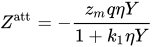
and
for spherical molecules
- For non-spherical molecules, the following relation is suggested
where
- The reduced number density
is defined as

where
is the characteristic size parameter
is the number of molecules
The characteristic size parameter is related to the shape parameter

where
and
is Boltzmann's constant.
Noting the relationships between Boltzmann's constant and the Universal gas constant, and observing that the number of molecules can be expressed in terms of Avogadro's number and the molar mass, the reduced number density
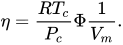
The shape parameter 

(and is hence also equal to 1 for spherical molecules).
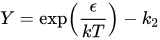
where 

,
,
and
are constants in the equation of state:
for spherical molecules (c=1)
for spherical molecules (c=1)
for spherical molecules (c=1)

The model can be extended to associating components and mixtures of nonassociating components. Details are in the paper by J.R. Elliott, Jr. et al. (1990).[20]
Cubic-Plus-Association
The Cubic-Plus-Association (CPA) equation of state combines the Soave-Redlich-Kwong equation with an association term from Wertheim theory.[21] The development of the equation began in 1995 as a research project that was funded by Shell, and in 1996 an article was published which presented the CPA equation of state.[21][22]
![{\displaystyle P={\frac {RT}{(V-b)}}-{\frac {a}{V(V+b)}}+{\frac {RT}{V}}\rho \sum _{A}\left[{\frac {1}{X^{A}}}-{\frac {1}{2}}\right]{\frac {\partial X^{A}}{\partial \rho }}}](https://wikimedia.org/api/rest_v1/media/math/render/svg/6cbd434d11122538f320972751c749f06e589165)
In the association term 
Non-cubic equations of state
Dieterici equation of state

where a is associated with the interaction between molecules and b takes into account the finite size of the molecules, similar to the Van der Waals equation.
The reduced coordinates are:

Virial equations of state
Virial equation of state

Although usually not the most convenient equation of state, the virial equation is important because it can be derived directly from statistical mechanics. This equation is also called the Kamerlingh Onnes equation. If appropriate assumptions are made about the mathematical form of intermolecular forces, theoretical expressions can be developed for each of the coefficients. A is the first virial coefficient, which has a constant value of 1 and makes the statement that when volume is large, all fluids behave like ideal gases. The second virial coefficient B corresponds to interactions between pairs of molecules, C to triplets, and so on. Accuracy can be increased indefinitely by considering higher order terms. The coefficients B, C, D, etc. are functions of temperature only.
One of the most accurate equations of state is that from Benedict-Webb-Rubin-Starling[23] shown next. It was very close to a virial equation of state. If the exponential term in it is expanded to two Taylor terms, a virial equation can be derived:

Note that in this virial equation, the fourth and fifth virial terms are zero. The second virial coefficient is monotonically decreasing as temperature is lowered. The third virial coefficient is monotonically increasing as temperature is lowered.
The BWR equation of state

where
- p is pressure
- ρ is molar density
Values of the various parameters for 15 substances can be found in K.E. Starling (1973). Fluid Properties for Light Petroleum Systems. Gulf Publishing Company.
Lee-Kesler equation of state
The Lee-Kesler equation of state is based on the corresponding states principle, and is a modification of the BWR equation of state.[24]
SAFT equations of state
Statistical associating fluid theory (SAFT) equations of state predict the effect of molecular size and shape and hydrogen bonding on fluid properties and phase behavior. The SAFT equation of state was developed using statistical mechanical methods (in particular perturbation theory) to describe the interactions between molecules in a system.[25][26][27] The idea of a SAFT equation of state was first proposed by Chapman et al. in 1988 and 1989.[25][26][27] Many different versions of the SAFT equation of state have been proposed, but all use the same chain and association terms derived by Chapman.[25][28][29] SAFT equations of state represent molecules as chains of typically spherical particles that interact with one another through short range repulsion, long range attraction, and hydrogen bonding between specific sites.[27] One popular version of the SAFT equation of state includes the effect of chain length on the shielding of the dispersion interactions between molecules (PC-SAFT).[30] In general, SAFT equations give more accurate results than traditional cubic equations of state, especially for systems containing liquids or solids.[31][32]
Multiparameter equations of state
Helmholtz Function form
Multiparameter equations of state (MEOS) can be used to represent pure fluids with high accuracy, in both the liquid and gaseous states. MEOS's represent the Helmholtz function of the fluid as the sum of ideal gas and residual terms. Both terms are explicit in reduced temperature and reduced density - thus:

where:
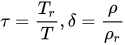
The reduced density and temperature are typically, though not always, the critical values for the pure fluid.
Other thermodynamic functions can be derived from the MEOS by using appropriate derivatives of the Helmholtz function; hence, because integration of the MEOS is not required, there are few restrictions as to the functional form of the ideal or residual terms. Typical MEOS use upwards of 50 fluid specific parameters, but are able to represent the fluid's properties with high accuracy. MEOS are available currently for about 50 of the most common industrial fluids including refrigerants. Mixture models also exist.
Other equations of state of interest
Stiffened equation of state
When considering water under very high pressures, in situations such as underwater nuclear explosions, sonic shock lithotripsy, and sonoluminescence, the stiffened equation of state is often used:

where 


The equation is stated in this form because the speed of sound in water is given by 
Thus water behaves as though it is an ideal gas that is already under about 20,000 atmospheres (2 GPa) pressure, and explains why water is commonly assumed to be incompressible: when the external pressure changes from 1 atmosphere to 2 atmospheres (100 kPa to 200 kPa), the water behaves as an ideal gas would when changing from 20,001 to 20,002 atmospheres (2000.1 MPa to 2000.2 MPa).
This equation mispredicts the specific heat capacity of water but few simple alternatives are available for severely nonisentropic processes such as strong shocks.
Ultrarelativistic equation of state
An ultrarelativistic fluid has equation of state

where 

Ideal Bose equation of state
The equation of state for an ideal Bose gas is
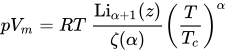
where α is an exponent specific to the system (e.g. in the absence of a potential field, α = 3/2), z is exp(μ/kT) where μ is the chemical potential, Li is the polylogarithm, ζ is the Riemann zeta function, and Tc is the critical temperature at which a Bose–Einstein condensate begins to form.
Jones–Wilkins–Lee equation of state for explosives (JWL equation)
The equation of state from Jones–Wilkins–Lee is used to describe the detonation products of explosives.

The ratio 


Equations of state for solids and liquids
Common abbreviations:
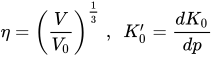
- Tait equation for water and other liquids. Several equations are referred to as the Tait equation.
- Murnaghan equation of state
![{\displaystyle p(V)={\frac {K_{0}}{K_{0}'}}\left[\eta ^{-3K_{0}'}-1\right]}](https://wikimedia.org/api/rest_v1/media/math/render/svg/119acc194c6fe4b55cdb04509f35d2de82943be0)
- Birch–Murnaghan equation of state

- Stacey-Brennan-Irvine equation of state[35] (falsely often refer to Rose-Vinet equation of state)
![{\displaystyle p(V)=3K_{0}\left({\frac {1-\eta }{\eta ^{2}}}\right)\exp \left[{\frac {3}{2}}\left(K_{0}'-1\right)(1-\eta )\right]}](https://wikimedia.org/api/rest_v1/media/math/render/svg/84b54e6697098407c42a951f4d417f550947640c)
- Modified Rydberg equation of state[36][37][38] (more reasonable form for strong compression)
![{\displaystyle p(V)=3K_{0}\left({\frac {1-\eta }{\eta ^{5}}}\right)\exp \left[{\frac {3}{2}}\left(K_{0}'-3\right)(1-\eta )\right]}](https://wikimedia.org/api/rest_v1/media/math/render/svg/72f0bf0c52a562fef450596bac5bab2a9ceb64a6)
- Adapted Polynomial equation of state[39] (second order form = AP2, adapted for extreme compression)
- with
- where
= 0.02337 GPa.nm5. The total number of electrons
in the initial volume
determines the Fermi gas pressure
, which provides for the correct behavior at extreme compression. So far there are no known "simple" solids that require higher order terms.
![{\displaystyle p(V)=3K_{0}\left({\frac {1-\eta }{\eta ^{5}}}\right)\exp \left[c_{0}(1-\eta )\right]\left\{1+c_{2}\eta (1-\eta )\right\}}](https://wikimedia.org/api/rest_v1/media/math/render/svg/d6a84eadfd547167097d76e43eabe588d3fe49e7)

- Adapted polynomial equation of state[39] (third order form = AP3)
![{\displaystyle p(V)=3K_{0}\left({\frac {1-\eta }{\eta ^{5}}}\right)\exp \left[c_{0}(1-\eta )\right]\left\{1+c_{2}\eta (1-\eta )+c_{3}\eta (1-\eta )^{2}\right\}}](https://wikimedia.org/api/rest_v1/media/math/render/svg/d845ea54ae72a8b5098788d19cb3f9c3c1bb1bd2)
- Johnson–Holmquist equation of state

- Mie–Grüneisen equation of state (for a more detailed discussion see ref.[40])
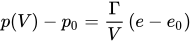
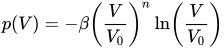
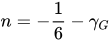
- Anton-Schmidt equation of state
- where
is the bulk modulus at equilibrium volume
typically about −2 is often related to the Grüneisen parameter by
This article uses material from the Wikipedia article
Metasyntactic variable, which is released under the
Creative Commons
Attribution-ShareAlike 3.0 Unported License.