In fluid dynamics the Milne-Thomson circle theorem or the circle theorem is a statement giving a new stream function for a fluid flow when a cylinder is placed into that flow.[1][2] It was named after the English mathematician L. M. Milne-Thomson.
Let be the complex potential for a fluid flow, where all singularities of lie in . If a circle is placed into that flow, the complex potential for the new flow is given by[3]



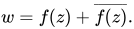
with same singularities as in and is a streamline. On the circle , , therefore

Example
Consider a uniform irrotational flow 



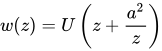
represents the complex potential of uniform flow over a cylinder.
| This article uses material from the Wikipedia article Metasyntactic variable, which is released under the Creative Commons Attribution-ShareAlike 3.0 Unported License. |