A Rollin film, named after Bernard V. Rollin, is a 30 nm-thick liquid film of helium in the helium II state. It exhibits a "creeping" effect in response to surfaces extending past the film's level (wave propagation). Helium II can escape from any non-closed container via creeping toward and eventually evaporating from capillaries of 10−7 to 10−8 meters or greater.
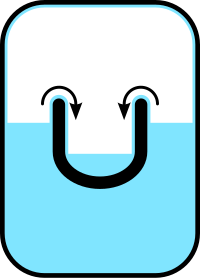
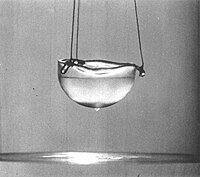
Rollin films are involved in the fountain effect where superfluid helium leaks out of a container in a fountain-like manner. They have high thermal conductivity.
The ability of superfluid liquids to cross obstacles that lie at a higher level is often referred to as the Onnes effect, named after Heike Kamerlingh Onnes. The Onnes effect is enabled by the capillary forces dominating gravity and viscous forces.
Waves propagating across a Rollin film are governed by the same equation as gravity waves in shallow water, but rather than gravity, the restoring force is the van der Waals force. The film suffers a change in chemical potential when the thickness varies. These waves are known as third sound.
Thickness of the film
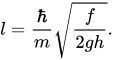
The thickness of the film can be calculated by the energy balance. Consider a small fluid volume element 




| This article uses material from the Wikipedia article Metasyntactic variable, which is released under the Creative Commons Attribution-ShareAlike 3.0 Unported License. |