Simple shear is a deformation in which parallel planes in a material remain parallel and maintain a constant distance, while translating relative to each other.

In fluid mechanics
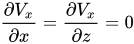
In fluid mechanics, simple shear is a special case of deformation where only one component of velocity vectors has a non-zero value:


And the gradient of velocity is constant and perpendicular to the velocity itself:
,
where 
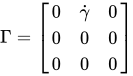
The displacement gradient tensor Γ for this deformation has only one nonzero term:
Simple shear with the rate
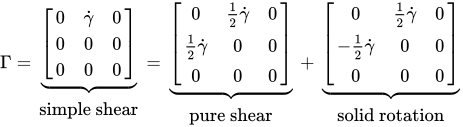
The mathematical model representing simple shear is a shear mapping restricted to the physical limits. It is an elementary linear transformation represented by a matrix. The model may represent laminar flow velocity at varying depths of a long channel with constant cross-section. Limited shear deformation is also used in vibration control, for instance base isolation of buildings for limiting earthquake damage.
In solid mechanics
In solid mechanics, a simple shear deformation is defined as an isochoric plane deformation in which there are a set of line elements with a given reference orientation that do not change length and orientation during the deformation.[1] This deformation is differentiated from a pure shear by virtue of the presence of a rigid rotation of the material.[2][3] When rubber deforms under simple shear, its stress-strain behavior is approximately linear.[4] A rod under torsion is a practical example for a body under simple shear.[5]
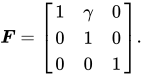
If e1 is the fixed reference orientation in which line elements do not deform during the deformation and e1 − e2 is the plane of deformation, then the deformation gradient in simple shear can be expressed as
We can also write the deformation gradient as

Simple shear stress–strain relation
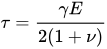
In linear elasticity, shear stress, denoted 


where 
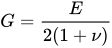
Here 

| This article uses material from the Wikipedia article Metasyntactic variable, which is released under the Creative Commons Attribution-ShareAlike 3.0 Unported License. |