In fluid dynamics, stagnation point flow represents the flow of a fluid in the immediate neighborhood of a solid surface. As the fluid approaches the surface it divides into two streams. Although the fluid is stagnant everywhere on the solid surface due to no-slip condition, the name stagnation point refers to the stagnation points of inviscid Euler solutions.
Hiemenz flow[1][2]Edit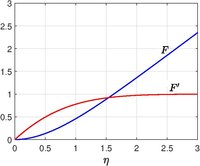
Two-dimensional stagnation point flow
Hiemenz[3] formulated the problem and calculated the solution numerically in 1911 and subsequently by Leslie Howarth (1934).[4] The flow in the neighborhood of the stagnation point can be modeled by a flow towards an infinite flat plate, even though the whole body is a curved one (local curvature effects are negligible). Let the plate be in the  plane with
 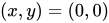 representing the stagnation point. The inviscid stream function
  and velocity
  from Potential flow theory are

where  is an arbitrary constant (represents strain rate in the counter flow setup). For real fluid (including viscous effects), there exists a self-similar solution if one defines
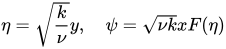
where  is the Kinematic viscosity and
  is a boundary layer thickness but it is constant (vorticity generated at the solid surface is prevented diffusing far away by an opposing convection, similar profiles are Blasius boundary layer with suction, Von Kármán swirling flow etc.,). Then the velocity components and subsequently pressure and the equation for
  using Navier–Stokes equations are


and the boundary condition due to no penetration and no-slip and the free stream condition for  (Note boundary conditions for
  far away from the plate is not specified, because it is part of the solution - a typical boundary layer problem) are

The problem formulated here is the special case of Falkner-Skan boundary layer. The asymptotic forms for large  are
are

where  is the displacement thickness.
Stagnation point flow with translating plate[5]Edit
Stagnation point flow with moving plate with constant velocity  can be considered as model for rotating solids near the stagnation points. The stream function is

where  satisfies the equation

and Rott (1956)[6] gave the solution as 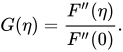
Oblique stagnation point flowEdit
The previous analyses assumes the flow impinges in normal direction. The inviscid stream function for oblique stagnation point flow is obtained by adding a constant vorticity  .
.
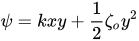
The corresponding analysis for viscous fluid is studied by Stuart (1959),[7] Tamada (1979)[8] and Dorrepaal (1986).[9] The self-similar stream function is,

where  satisfies the equation
 .
.
Homann flowEdit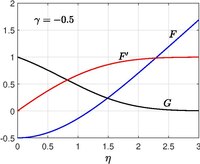
Homann flow with injection
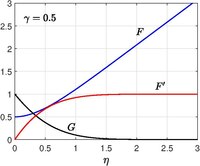
Homann flow with suction
The corresponding problem in axisymmetric coordinate is solved by Homann (1936)[10] and this serves a model for flow around near the stagnation point of a sphere. Paul A. Libby (1974)[11](1976)[12] considered Homann flow with constantly moving plate with velocity and also allowed for suction/injection with velocity  at the surface.
The self-similar solution is obtained by introducing following transformation for the velocity  in cylindrical coordinates

and the pressure is given by

Therefore, the Navier–Stokes equations reduce to
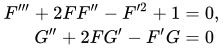
with boundary conditions,

When  , the classical Homann problem is recovered.
Plane counterflowsEditJets emerging from a slot-jets creates stagnation point in between according to potential theory. The flow near the stagnation point can by studied using self-similar solution. This setup is widely used in combustion experiments. The initial study of impinging stagnation flows are due to C.Y. Wang.[13][14] Let two fluids with constant properties denoted with suffix  flowing from opposite direction impinge, and assume the two fluids are immiscible and the interface (located at
  ) is planar. The velocity is given by

where  are strain rates of the fluids. At the interface, velocities, tangential stress and pressure must be continuous. Introducing the self-similar transformation,


results equations,


The no-penetration condition at the interface and free stream condition far away from the stagnation plane become

But the equations require two more boundary conditions. At  , the tangential velocities
  , the tangential stress
  and the pressure
  are continuous. Therefore,
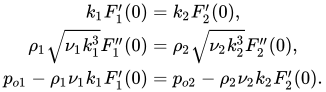
where  (from outer inviscid problem) is used. Both
  are not known apriori, but derived from matching conditions. The third equation is determine variation of outer pressure
  due to the effect of viscosity. So there are only two parameters, which governs the flow, which are
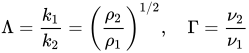
then the boundary conditions become
 .
.
Constant density and constant viscosityEdit
When densities and viscosities of the two impinging jets are same and constant, then the strain rate is also constant  and the potential flow solution become the solution of the Navier-Stokes equations, i.e.,

everywhere in the flow domain. Kerr and Dold found additional new solution called as Kerr–Dold vortex of Navier-Stokes equations in 1994 in the form of periodic array of steady vortices superposed on the constant density and constant viscosity counterflowing jets.