In fluid mechanics, the Tait equation is an equation of state, used to relate liquid density to pressure. The equation was originally published by Peter Guthrie Tait in 1888 in the form[1]

where is the reference pressure (taken to be 1 atmosphere), is the current pressure, is the volume of fresh water at the reference pressure, is the volume at the current pressure, and are experimentally determined parameters.

Popular form of the Tait equation
Around 1895,[1] the original isothermal Tait equation was replaced by Tammann with an equation of the form
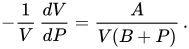
The temperature-dependent version of the above equation is popularly known as the Tait equation and is commonly written as[2]
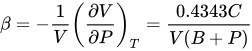
or in the integrated form
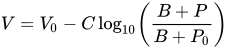
where
is the compressibility of the substance (often, water) (in units of bar−1 or Pa)
is the specific volume of the substance (in units of ml/g or m3/kg)
is the specific volume at
= 1 bar
and
are functions of temperature that are independent of pressure[2]
Pressure formula
The expression for the pressure in terms of the specific volume is
![{\displaystyle P=(B+P_{0})\,10^{\left[-{\cfrac {V-V_{0}}{C}}\right]}-B\,.}](https://wikimedia.org/api/rest_v1/media/math/render/svg/2c67c175982ce2c4dcc7b759d563e3ef6d727b8d)
Bulk modulus formula
The tangent bulk modulus at pressure 
}{0.4343C}}\,.}](https://wikimedia.org/api/rest_v1/media/math/render/svg/2b04e0d449cde47551204b5e772a8076708da6ed)
Murnaghan-Tait equation of state

Another popular isothermal equation of state that goes by the name "Tait equation"[3][4] is the Murnaghan model[5] which is sometimes expressed as
![{\displaystyle {\frac {V}{V_{0}}}=\left[1+{\frac {n}{K_{0}}}\,(P-P_{0})\right]^{-1/n}}](https://wikimedia.org/api/rest_v1/media/math/render/svg/f9a792ef1b0a3bb29f077c3cdeffbcc0ce4a2043)
where 


Pressure formula
This equation, in pressure form, can be written as
![{\displaystyle P={\frac {K_{0}}{n}}\left[\left({\frac {V_{0}}{V}}\right)^{n}-1\right]+P_{0}={\frac {K_{0}}{n}}\left[\left({\frac {\rho }{\rho _{0}}}\right)^{n}-1\right]+P_{0}.}](https://wikimedia.org/api/rest_v1/media/math/render/svg/5888d0ba09b07f8942856a4a5afeb4eb3e58e634)
where 


Note that this form of the Tate equation of state is identical to that of the Murnaghan equation of state.
Bulk modulus formula
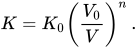
The tangent bulk modulus predicted by the MacDonald-Tait model is
Tumlirz-Tammann-Tait equation of state

A related equation of state that can be used to model liquids is the Tumlirz equation (sometimes called the Tammann equation and originally proposed by Tumlirz in 1909 and Tammann in 1911 for pure water).[1][6] This relation has the form

where 


The Tumlirz-Tammann version of the Tait equation for fresh water, i.e., when 
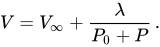
For pure water, the temperature-dependence of 

In the above fits, the temperature 
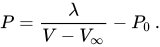
Pressure formula
The inverse Tumlirz-Tammann-Tait relation for the pressure as a function of specific volume is
Bulk modulus formula
The Tumlirz-Tammann-Tait formula for the instantaneous tangent bulk modulus of pure water is a quadratic function of

| This article uses material from the Wikipedia article Metasyntactic variable, which is released under the Creative Commons Attribution-ShareAlike 3.0 Unported License. |